

Intent-Driven Content, Orchestration, and the End of Per-Word Pricing
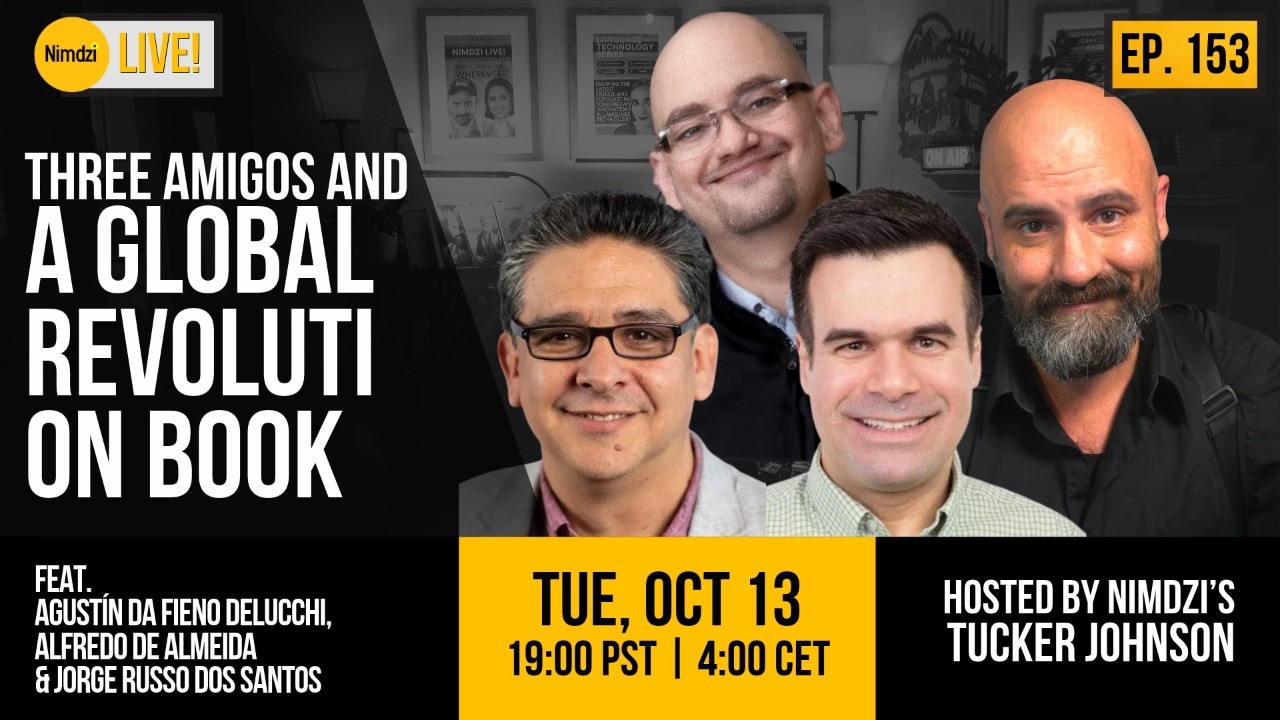
As artificial intelligence automates core localization mechanics, the language industry faces a fundamental structural shift across content generation, workforce roles, and commercial models. On a recent episode of Nimdzi Live, host Tucker Johnson, Board Member and Co-Founder of Nimdzi Insights, sat down with University of Washington localization lecturers Alfredo de Almeida, Jorge Russo Dos Santos, and Agustin da Fieno Delucchi. Ahead of LocWorld56 Vancouver, the group discussed insights from their new book, Three Amigos and a Global Revolution, exploring how localization teams and language service providers (LSPs) must adapt to survive.
Intent-Driven Creation Replaces Sequential Translation
The traditional workflow of translating segment-by-segment from an English source text is giving way to Intent-Driven Content Creation (IDCC). Agustin da Fieno Delucchi and Jorge Russo Dos Santos argue that relying strictly on English source files introduces inherent cultural biases and semantic constraints. By using AI to generate parallel localized content directly from core business intent, organizations can target multiple languages simultaneously.
Human expertise remains crucial to define context and prevent translation errors. As Johnson summarized during the discussion, "Why are we treating the source content like it's the word of God?" Except for strictly regulated legal or compliance content where exact translation remains mandatory, high-volume marketing and UI copy will increasingly move toward prompt-driven, localized content synthesis.
Transitioning from Program Managers to Content Orchestrators
Operational automation is pushing localization managers to evolve from technical file parsers into holistic "content orchestrators." According to da Fieno Delucchi and Russo Dos Santos, professionals in these emerging roles require a hybrid skill set spanning cross-cultural awareness, technical fluency, product management, and market strategy. Rather than acting as passive human-in-the-loop processors, professionals must become authoritative decision-makers accountable for final product outcomes.
Addressing anxiety around industry automation, Johnson introduced "the Jello Effect." When market compression squeezes corporate localization teams, talent is not crushed; instead, it spills out to found agile startups and drive new tooling. Disruption historically expands the global volume of localized content rather than shrinking the market, proving the resilience of skilled talent. Reiteration of strategy remains key, as Russo Dos Santos noted, citing Eisenhower: "Plans are useless, but planning is indispensable."
The Decline of the Per-Word Commercial Model
The legacy per-word billing structure is functionally obsolete in an AI-driven environment. Both da Fieno Delucchi and Johnson emphasized that word-based pricing fails to align with Large Language Model (LLM) token mechanics. Token usage varies dramatically across complex non-Latin scripts—such as Bengali, where token counts can exceed word counts by roughly ten times.
As a result, commercial frameworks are transitioning toward token-based metrics, subscriptions, and outcome-focused pricing. Value is shifting away from simple volume throughput and toward market impact, risk mitigation, and contextual precision.
Reimagining LSPs as Regional Consultancies
As client-side tools empower internal teams and small businesses to generate localized copy directly, traditional LSP margins will compress. Russo Dos Santos and Alfredo de Almeida contend that LSPs relying solely on per-word translation will face shrinking revenues unless they transition into specialized regional consultancies, mirroring global management firms like McKinsey or PwC.
While basic execution is becoming commoditized, strategic guidance remains vital. As da Fieno Delucchi remarked, "If I would tell you that you don't need an LSP, I would be selling you snake oil." LSPs can secure their future by providing deep regional market entry strategies, terminology governance, and local product alignment.
Watch the full conversation and deep dive on YouTube.
Intelligence
Why this matters
- Shift to intent-driven content creation is essential.
- LSPs must adapt to survive in a changing market.
- Traditional billing models are becoming obsolete.
Keep independent coverage alive.
No ads. No paywall. No corporate backing. Just sharp, weekly intelligence on the language industry — free, because it should be.