

Beyond SEO: Managing Multilingual GEO and the AI-Mediated Brand
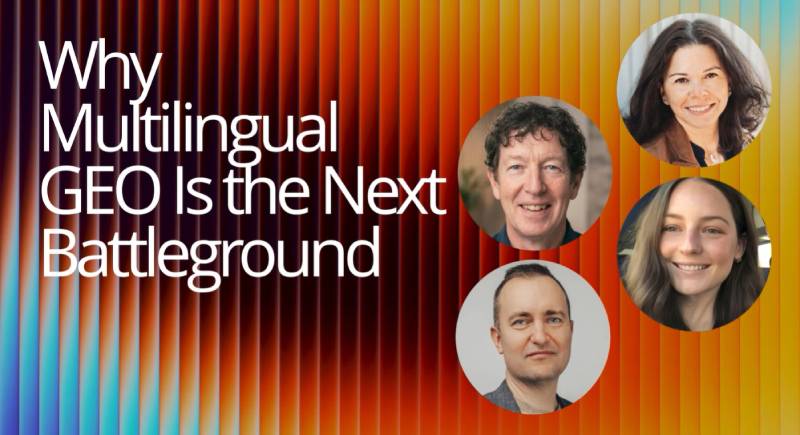
The search landscape is undergoing a tectonic shift. As consumers migrate from browsing lists of search engine links to reading synthesized AI answers, global enterprises must rethink how their brands are discovered across languages. In an episode of The Signal Room Podcast, host Wada'a Fahel, founder of LocVerse Consulting, sat down with Centific executives Karina Welch, Jonas Ryberg, and Vincent Swan to unpack the rise of Generative Engine Optimization (GEO) and its profound implications for localization technology and global content strategy.
The Transition from SEO to GEO
Traditional Search Engine Optimization (SEO) was a highly controllable "game." Companies could easily hack the system using keywords and link-building to rank on the first page of search results, driving consumers to click and scroll through their websites.
According to the panel, this model is rapidly being replaced by GEO. In this new paradigm, AI engines synthesize brand information from across the web. The brand's objective shifts from "being found" to "influencing the synthesized answer." AI-mediated search eliminates the step where consumers browse multiple sites; instead, the AI system decides which brands make the cut based on specific user criteria.
This shifts brand control from direct messaging on owned channels—such as a corporate homepage—to managing the broader digital footprint that Large Language Models (LLMs) train on. For example, Wada'a used Claude for a hotel search in San Francisco, receiving a synthesized recommendation rather than a list of links. Karina tracked this shift using Podium Labs to analyze AI-driven traffic sources, discovering that referrals from AI sources to Centific's site rose from 0% to over 3% between May and September.
Multilingual Discrepancies in AI Search and Prompts
One of the most critical challenges for global brands is that LLMs do not reason or rank companies identically across different languages, even when given identical translated prompts.
Jonas tested identical prompts in Swedish, English, and German, which yielded entirely different rankings and reasoning behaviors from the chatbots. In English and Swedish, the AI evaluated only the current state of the companies. However, in German, the AI spontaneously factored in "future potential" to rank the top five localization companies, introducing a competitor that did not appear in the other languages. This demonstrates that localized online presence directly impacts how regional AI systems perceive and prioritize a brand, highlighting the critical need for localized, multilingual GEO.
Redesigning Content and Localization Strategies for LLM Scraping
To survive the transition to GEO, localization must pivot from translating keywords for human eyes to structuring high-quality, authoritative regional content that AI models can easily ingest and summarize.
Vincent points out that AI search agents often read only the first 40 to 50 lines of an article before moving on. Therefore, critical answers and core brand value propositions must be positioned at the very top of the content structure. Furthermore, LLMs crawl dense, authoritative documents—such as white papers, technical repositories, and product knowledge bases—rather than typical marketing landing pages.
Jonas notes that Google's published search guidelines recommend expanding regional content and prioritizing "good, locally relevant, original content" rather than trying to trick the engine. Additionally, Google does not use standard directives like LLMs.txt to block scraping, assuming its right to index everything to build its ecosystem.
AI Agent "Civilizations" and the Hype Cycle
The vocabulary used to describe AI is also shifting. The panel discussed how developers are demonstrating three-wave agent architectures, where successive waves of agents read, recover, and build upon the messages left by prior waves.
Using terms like "civilizations" to describe these hierarchical workflows—discussed in spaces like Hugging Face, OpenAI, and Dwarkesh Patel's podcast and blog—represents a strategic effort to shift the narrative toward proof of machine sentience. Vincent argues these are simply structured organizational models, contrasting "demos" that show what is possible with actual "proof" validating that a system delivers the implied capability.
Practical Takeaways for Localization Leaders
- Audit AI referral traffic immediately: Track and analyze where your incoming traffic originates to see if LLMs and AI search engines like Claude, Perplexity, or ChatGPT are driving user visits. (Karina Welch)
- Front-load key information in articles: Structure digital content so that answers and core brand value propositions appear in the first 40 to 50 lines to accommodate the truncated reading patterns of AI web crawlers. (Vincent Swan)
- Prioritize authority over keywords: Focus content strategies on deep topic authority—building extensive, structured knowledge bases, product Wikis, and GitHub repositories—as LLMs rely heavily on these for syntheses. (Karina Welch)
- Localize the brand narrative holistically: Ensure that third-party forums, local reviews, and regional industry blogs like Reddit or Substack reflect your desired brand messaging, as these are the exact sources scraped by LLMs to determine regional brand credibility. (Karina Welch)
Listen to the full conversation on Spotify or watch the episode on YouTube.
Intelligence
Why this matters
- Brands must adapt to AI-driven search dynamics.
- Localized content is crucial for visibility in AI results.
- Traditional SEO strategies are becoming obsolete.
Keep independent coverage alive.
No ads. No paywall. No corporate backing. Just sharp, weekly intelligence on the language industry — free, because it should be.